"My idea was to surround a golf course with executive housing . . . for want of a better word," J. Robert Sierra told the St. Petersburg Times in 1995. He added, "I had no idea the houses were going to get as big as they got."
That quote holds Avila's whole history in two sentences. Sierra started with the course, and the houses were supposed to be the frame around it. Today the homes are what most people picture first. Look at the records from the 1970s, 1980s and 1990s, though, and the course is the anchor of every chapter. More than four decades later, the club's own governing documents still put it at the center.
A golf answer to a membership problem
Sierra explained his reasoning plainly. Getting into Palma Ceia, which the 1995 article called Tampa's top country club, was hard for newcomers. He also had a large piece of land in northwest Hillsborough County. One fact solved the other. If people moving to Tampa couldn't get into the established club easily, he would build them another one and put their houses on its fairways.
He had been preparing for decades. A 1991 Times profile reported that Sierra began assembling the Avila parcels in 1962. The Avila Property Owners' Association describes the land he put together as lakes, stands of oak, pine and cypress, and conservation areas among Florida orange groves. The size of the site varies by source. The 1991 article puts it at 725 acres, Sierra Properties' executive biography says 850, and the POA says roughly 900.
The order of construction backs up Sierra's account. According to the 1991 Times, work on the golf course started in 1978, and development of the subdivision began a year after that. The course came first by a full year.
The sequence, year by year
- 1962. Sierra begins assembling the parcels.
- August 8, 1978. SICO, Inc., the Sierra family company that later appears in the club's bylaws as its owner, files with the state of Florida.
- 1978. Construction begins on the golf course.
- 1979. Development of the subdivision begins.
- 1980. The POA dates the building of Avila Golf & Country Club to this year. The first resident moves in that March.
- 1983. Sierra and Jack Nicklaus form Nicklaus/Sierra Development Corporation.
- 1988. Nicklaus redesigns the Avila course.
The corporation that would own the club was registered in the same year the first fairways were being shaped. Sierra set up the business behind the golf at the same moment he started building it.
Why every street ends in "de Avila"
The name came next. The POA says Sierra named the community after the famed fortress city of Ávila in Spain, gave the streets the names of Spanish cities, and designed the country club as a clear nod to Spanish architecture. The 1991 Times put it the same way, noting that Avila, "like the historic walled Spanish city for which it is named," was bordered by a high privacy wall and natural barriers.
The pattern shows up across Hillsborough County's plat records, which carry names such as Millan de Avila, Comunidad de Avila and Villalagos de Avila. The best known of them is Guisando de Avila. The club's bylaws list its registered office at 943 Guisando de Avila. SICO's current state filing gives its principal address farther down the same street, at 509 Guisando de Avila.
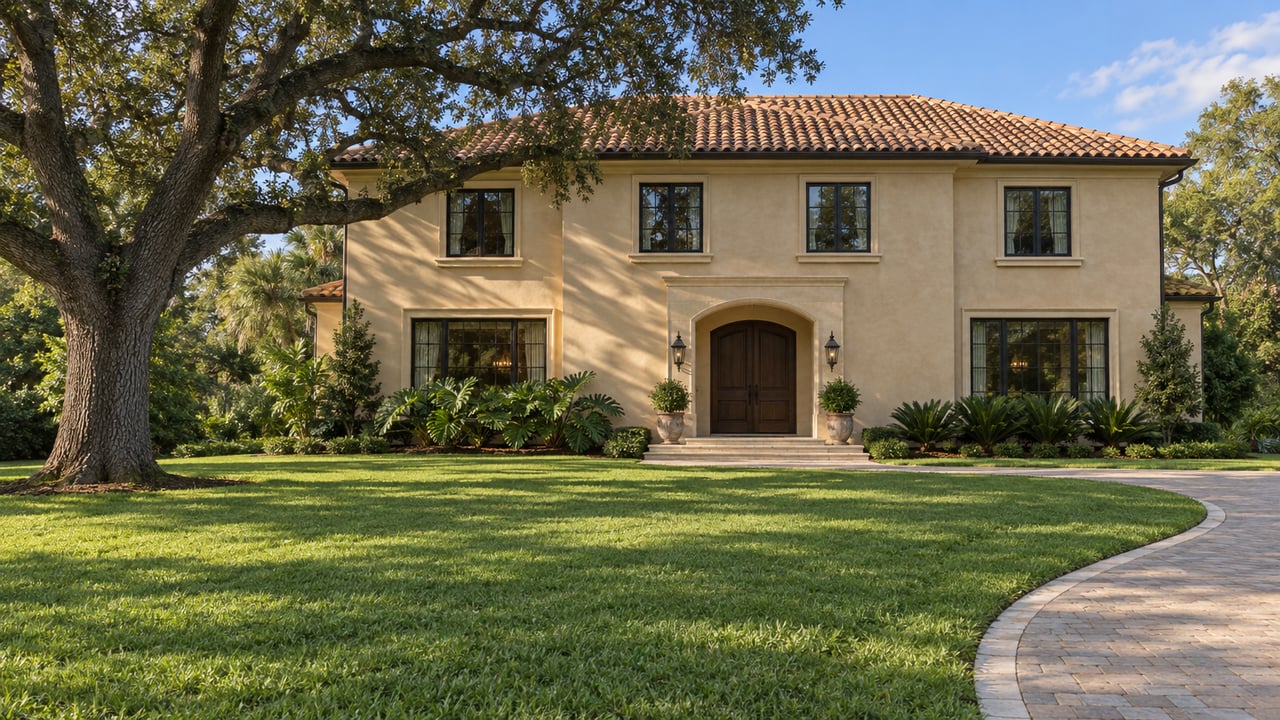
The Spanish theme was firm on the street signs and the clubhouse, and much looser on the houses. In 1991 the Times counted Spanish, Country French, Georgian, Tudor and Contemporary styles inside the wall. Buyers could choose one of the community's builders or hire their own designer and builder. Sierra set the frame and let owners decide what went inside it. That approach explains much of the variety you see on a drive past Avila's homes today.
The houses outgrew the frame
The houses are where Sierra's plan went past what he expected. "A lot of people told me it couldn't be done," he told the Times in 1991, answering critics who said Tampa wasn't ready for so pricey a community. "Obviously, it's much grander than I envisioned it to be. People are putting a lot of money into their houses."
By then, estate homes in Avila were priced as high as $4 million. Four years later, the Times described Avila as a place where 6,000-square-foot homes had become common and said it helped set the standard for new luxury in the region. The same reporting noted that about half of the most expensive homes in Hillsborough and Pinellas counties were in neighborhoods that hadn't existed 15 years earlier. Large stretches of open land made that possible.
One early detail even puzzled the county. Avila Realty's sales director told the Times in 1991 that guest houses were popular in Avila and that "the county gets upset" because officials saw a main house and a guest house as two houses on one lot. Owners used the cottages for entertaining, for guests and for nannies. The "executive housing" Sierra pictured around a golf course had grown into houses with houses of their own.
Some of the people who lived there were well known. The 1991 profile named NBC golf commentator and PGA Tour winner Gary Koch, former baseball manager Dick Williams, Tampa Bay Rowdies owners Richard and Cornelia Corbett, and former Buccaneers coach Ray Perkins, who had recently moved to Tuscaloosa. A 2015 Times neighborhood profile added names such as Derek Jeter, Mariano Rivera, Jorge Posada, Eddie DeBartolo, Vince Naimoli and Tony Dungy, all of whom lived or had lived in Avila.
Nicklaus came in as Sierra's partner
The best-known name tied to the course arrived through business. In 1983, Sierra and Jack Nicklaus formed Nicklaus/Sierra Development Corporation to build golf communities across the country. Sierra Properties' biography says Avila served as the benchmark for the later Nicklaus communities, with Sierra as president and CEO. Those projects included Country Club of the South near Atlanta, Wynstone near Chicago, English Turn in New Orleans, Bear Creek in Murrieta, California, and Country Club of Louisiana in Baton Rouge.
So Avila was Sierra's own golf community and also the model for the ones that came after it. Five years into the partnership, in 1988, Nicklaus redesigned Avila's own course. The records found so far don't name whoever laid out the original 1978 course. Every attribution on record is to Nicklaus's redesign.
The course started drawing serious players early. Gary Koch won the Central Chapter PGA Championship at Avila in 1991. In November 1992, the Times covered the 10th annual Invitational de Avila, where Steve Smyers was defending his title from the year before. Ten editions by 1992 puts the first Invitational around the club's first few seasons.
The course is still a family holding
The clearest sign that Avila began as a golf course is a document most homeowners probably never read. The club's published bylaws spell out who owns it:
"The owner of the Club is SICO, Inc. SICO, Inc. is owned by J. Robert Sierra and his immediate family."
The next section makes the club non-equity. Whatever happens to the money members pay, ownership of the course and every club facility "is and will remain vested solely in the corporation." Members have no ownership or equity rights and no responsibility for the club's debts or operating costs. The bylaws also include a family clause. If the owner ever proposed selling the club to anyone outside the circle of Sierra, his spouse, his lineal descendants, their spouses or their affiliates, members would have a right of first refusal to buy it on the same terms.
The bylaws online aren't dated. The state record for SICO is. Florida's Division of Corporations lists SICO, Inc. as an active corporation. Its 2026 annual report, filed January 21, 2026, lists John R. Sierra Jr. as president, J. Robert Sierra as a director, Stuart Sierra and Michael Sierra as officers, and J.R. Sierra III as assistant secretary. The POA's history says Sierra built the community with help from his three sons, John (Hi), Jr., Stuart and Michael. The company that registered in 1978 is still filing reports 48 years later, with the same family names in the officer slots and a J.R. Sierra III now among them.
That continuity reaches past Avila's walls. Sierra Properties' biography also credits Sierra with Bloomingdale and Northdale. The company lists Cypress Creek Town Center in Lutz, home of Tampa Premium Outlets, among its projects since 2013. Avila came first, and the family still holds the course at its center.
If your home has a story that goes back to Avila's first decades, such as an early Guisando lot, an original guest cottage, or a facade from the years when Tudor and Spanish stood side by side, that story is worth telling well when it's time to sell. Jose Cardenas pairs design-led preparation with storytelling and Sotheby's distribution to present homes with real history behind them. Let's Artfully Market Your Home.
This article is general information, not legal, tax or financial advice. Consult a qualified professional about your situation.