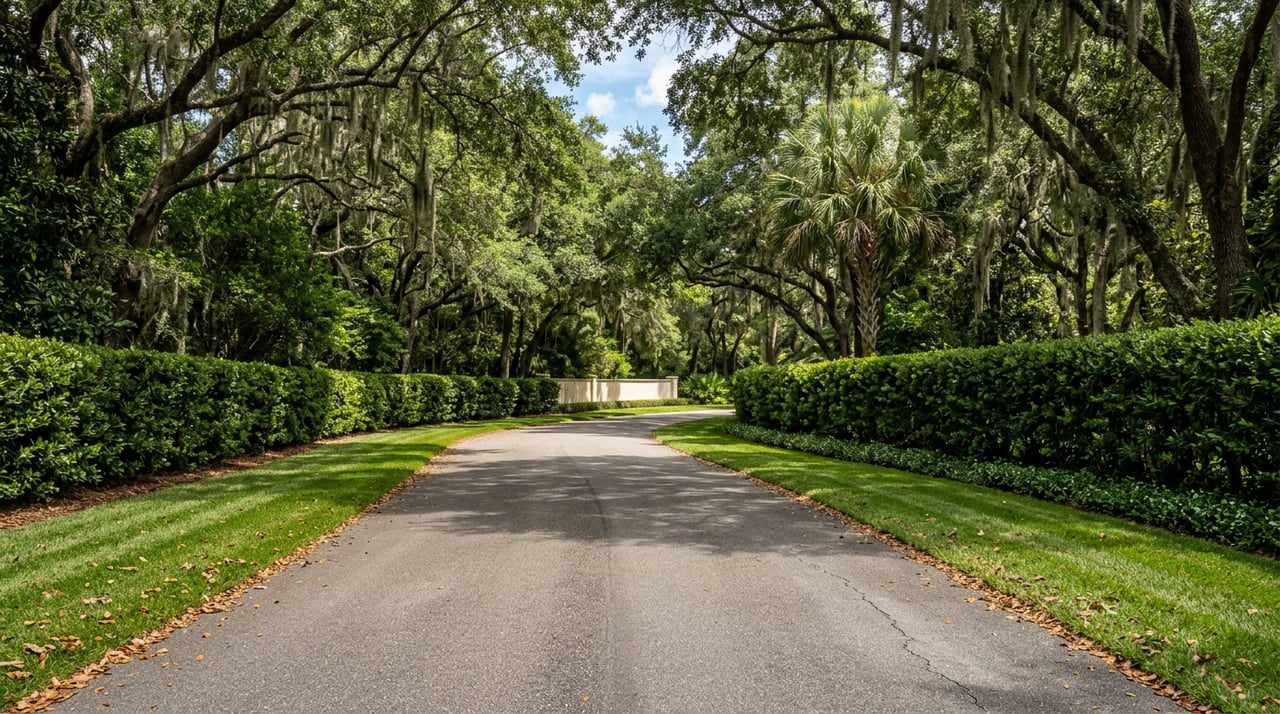
The school run in Avila rarely involves a car. A resident loads two kids into a golf cart, rolls past the dog park, waves to a neighbor trimming a hedge, and pulls up at the clubhouse for coffee before circling back home. The cart rolls along the private streets under the community's rules.
That casual freedom is not an accident of Florida sunshine or golf-course branding. It is the product of a legal distinction most residents have never had to think about, and it is the reason Avila's relationship with the golf cart looks nothing like the one playing out three miles south on Davis Islands.
The Fight Other Neighborhoods Had to Win
Davis Islands is Tampa's other famous cart neighborhood, and its cart culture has a founding story: in 2017, residents petitioned the city of Tampa to allow golf carts on public neighborhood roads. That petition mattered because Florida law treats a standard golf cart, capped under 20 miles per hour, as illegal on public roads unless a local government has specifically designated the route. Under Florida Statute 316.212, a county or municipality has to determine that a road can safely carry golf cart traffic, then post signs confirming it. Until that happens, the cart stays off the pavement. Davis Islands won that fight, and now it throws an annual parade to celebrate it, with residents decorating carts and cruising the same streets they once had to ask permission to use.
Avila never had to ask. Every road inside the gates is private property, maintained by the community's own association, not the city of Tampa. Florida law draws a clean line here: golf carts operated on private roads answer only to the association's own rules, not to a municipal designation process. There is no petition to file, no city council vote to win, no signage requirement to satisfy. The same eight-foot walls that give the neighborhood its seclusion also removed the entire legal hurdle that Davis Islands had to clear in public.
That is the piece of the story that gets lost in every generic "golf cart friendly neighborhoods" roundup: Avila's cart culture isn't a lifestyle amenity the community added on top of its privacy. It's a direct consequence of it.
Two Different Rulebooks, Two Different Carts
Here is where it gets specific enough to matter if you actually own one. A cart in Avila lives under two separate sets of rules depending on where it's rolling.
On the community's own streets, cart use is essentially the informal transportation layer of daily life. This is the cart that does the school run, the dog park loop, the quick trip to a neighbor's for coffee. It answers to the property owners' association, not to a Florida Department of Highway Safety registration process, because it never leaves private pavement.
Cross onto the golf course itself, and an entirely different rulebook takes over. Avila Golf & Country Club's own by-laws lay out specifics that have nothing to do with getting somewhere and everything to do with how the game gets played. Private cart owners have to pair up and share, since the club caps usage at one cart for every two riding golfers, whether it's a club fleet cart or a privately owned one. Pull carts aren't permitted at all. A power golf car can't carry more than two passengers or more than two bags at a time, and owning a private cart doesn't come with tournament entry discounts. Anyone who wants to bring their own cart onto the course has to register it through club management under a specific Privately Owned Golf Car Policy, separate entirely from whatever the neighborhood's own cart norms allow on the street outside.
In other words, the same golf cart that rolls past the mailbox on a Tuesday afternoon becomes a piece of tournament equipment the moment it turns onto the fairway, subject to pairing rules and bag limits that a city ordinance would never think to write.
The Geography That Makes the Math Work
None of this works as daily transportation if the neighborhood is too spread out to cover by cart, and Avila's layout was built at a scale that keeps everything inside comfortable range. The community sits on roughly 900 acres bounded loosely by Highway 41 to the west, Crenshaw Lake Road to the north, and Lake Magdalene Boulevard to the south, threaded through with a dozen private lakes and stretches of conservation land. Its longest street, Guisando de Avila, runs 1.17 miles end to end, which is the outer edge of what anyone here needs to cover on a single trip. Most errands, whether that's a swing by the pool pavilion, the tennis courts, or a friend's driveway, fall well inside that range.
Compare that to a low-speed vehicle registered for public roads, which under Florida law can legally travel any street posted at 35 miles per hour or under, once it's titled, insured, and equipped with headlights, turn signals, and a windshield to federal safety standards. That's a meaningful upgrade for someone who needs to cross a real town to reach a grocery store or a doctor's office. It is also a set of paperwork and equipment that most Avila residents simply never need, because the destinations that matter for a Tuesday afternoon already sit inside the walls.
What the Cart Can and Can't Do
The tradeoff is exactly what you'd expect from a private-road system: cart use under the community's rules inside the gates, and a hard stop at the guardhouse. A standard golf cart that has never been converted to a low-speed vehicle cannot legally cross onto Dale Mabry Highway or any other public road nearby, regardless of how well it performs inside Avila's own streets. That conversion process exists if a resident wants it, requiring a state vehicle inspection, a builder's statement, and enough documentation to satisfy the Florida Department of Highway Safety and Motor Vehicles, but it's a step most residents skip entirely. The whole appeal of the neighborhood's cart culture is that the conversion was never the point. The cart's job was always to move someone from a driveway on Villarreal de Avila to the clubhouse or the dog park, not to get them onto Interstate 275.
That's a genuinely different proposition than what a Davis Islands resident signed up for. Their carts, legalized for public streets after the 2017 petition, are built for a neighborhood where the destinations sit along a shared public grid. Avila's carts were designed, by virtue of the walls that came first, for a closed loop that never needed public sanction to exist.
The Quiet Logic Behind It
Step back and the golf cart turns into a small, specific proof of something larger about how this neighborhood was put together. The privacy that keeps Avila off the beaten path is the same infrastructure that gave residents an entire private transportation network without the municipal designation process that public-road cart communities had to negotiate one city council meeting at a time. Nobody in Avila had to win a vote to get here. The walls did that work in 1978, before the first cart ever rolled through the gates.
If you're weighing what daily life actually looks like inside a neighborhood like this, that's the kind of detail worth knowing before you tour a single home. For a closer look at the streets, the lake system, and the club at the center of it, the Avila neighborhood guide is a good place to start, and if you'd rather talk it through with someone who has spent years inside these gates, Jose Cardenas is ready to help you see the property behind the privacy. Let's artfully market your home.
This article is general information, not legal, tax or financial advice. Consult a qualified professional about your situation.